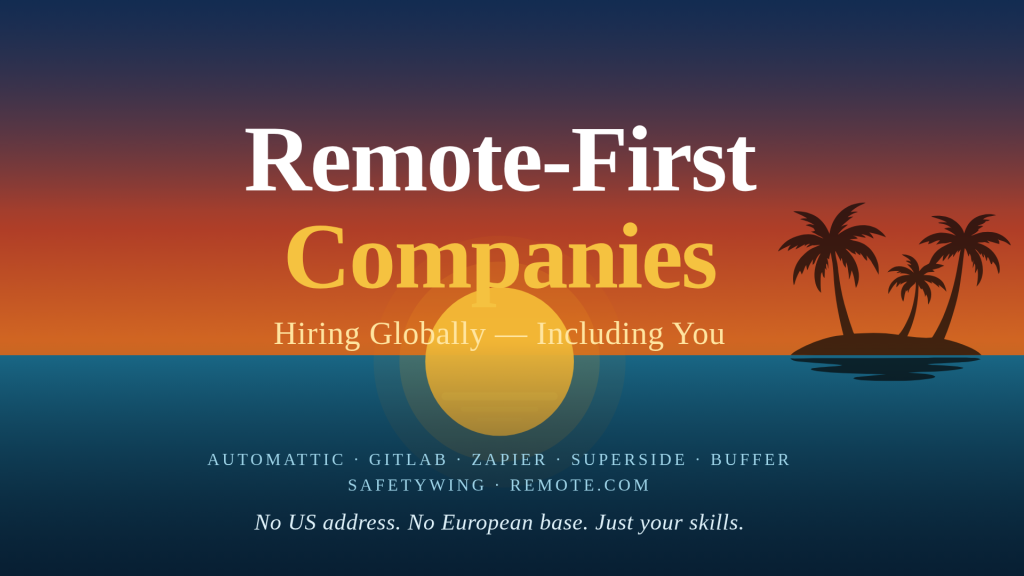
Remote-first companies hiring globally include Automattic, GitLab, Zapier, Superside, SafetyWing, Remote.com, and Buffer — all of which hire talent regardless of geographic location, with no requirement to be based in the US or Europe. Caribbean and Latin American professionals are eligible to apply, and the infrastructure to pay and employ them across borders already exists. The key differentiator is culture: these companies were built for distributed teams, not retrofitted for them.
If you’re in the Caribbean or Latin America and searching for remote work, the hardest part isn’t finding job boards. It’s knowing which companies will actually hire you — not tolerate you from a distance, but genuinely build a role around a distributed team member in your time zone. This post breaks down seven remote-first companies hiring globally in 2025, what each one looks for, and exactly how to approach your application.
What Makes a Company Truly Remote-First?
A remote-first company is one where distributed work is the founding architecture, not a pandemic-era accommodation.
The difference is not semantic. A company that reluctantly permits remote work will build its culture, performance reviews, and promotion tracks around physical presence. You will always be working against a current designed for someone else.
A remote-first company designs its communication, documentation, and decision-making for a globally distributed team from day one. Time zone differences are expected. Asynchronous work is the norm. Your location is a coordinate, not a disadvantage.
For Caribbean and Latin American professionals specifically, this distinction determines whether your career has room to grow — or whether you’re permanently the person on the other end of a bad video call.
Which Remote-First Companies Hire Caribbean and LatAm Professionals?
Seven companies stand out for combining genuine remote-first culture with truly global hiring — no US address, no European base required.
Automattic (automattic.com/work-with-us) employs over 1,700 people across 90+ countries and hires across engineering, marketing, finance, HR, and customer support. Their paid trial project gives candidates a real-work evaluation that mirrors the actual job.
GitLab (gitlab.com/jobs) is the gold standard for distributed work documentation — their public handbook tells you exactly how they hire and communicate before you apply. Roles span engineering, product, design, sales, and operations.
Zapier (zapier.com/jobs) is explicitly results-oriented and expanding its AI product lineup, making it relevant for professionals in automation, no-code development, product, and customer success.
Superside (careers.superside.com) is a creative-as-a-service company with a significant talent base already in Latin America and the Caribbean — designers, motion graphics artists, video editors, and brand strategists are actively recruited from our region.
SafetyWing (safetywing.com/careers) is a smaller, mission-driven company building global health insurance for distributed workers.
Remote.com (remote.com/careers) builds employer of record infrastructure — the legal plumbing that makes it possible for a company in San Francisco to hire someone in Barbados without setting up a local entity.
Buffer (buffer.com/journey) operates a four-day workweek, publishes every employee’s salary publicly, and hires across product, engineering, data, and marketing.
Why Do Remote-First Companies Matter for Caribbean Professionals?
Remote-first employers have already solved the problems that block Caribbean and LatAm professionals from traditional multinational hiring.
They have employer of record relationships or internal infrastructure to pay workers across borders legally. They have async communication cultures that accommodate time zone differences without penalising you. And critically, they have precedent — candidates from Trinidad, Jamaica, Colombia, and across the region have already been hired by companies on this list.
The practical barrier that remains is not geographic. It is preparation and visibility. Many professionals in our region underestimate their eligibility, apply hesitantly, and undersell their qualifications in the process. That gap is closeable — and closing it is the point of this series.
How Should Caribbean Professionals Approach Applying to These Companies?
The application strategy matters as much as the target list. Three principles apply across every company on this list:
- Research their culture before you apply. Every company listed has publicly available handbooks, culture pages, or transparency reports. Read them. Candidates who reference the company’s own operating language in an interview stand out immediately.
- Audit your written English. At every remote-first company on this list, written communication is the primary medium of your professional identity. Cover letters, Slack messages, and async updates are not secondary to your work — they are your work. Tools like Grammarly, Claude, and ChatGPT can help you refine your writing before it reaches a hiring manager.
- Apply even when you feel uncertain. The infrastructure to employ and pay you across borders exists. The precedent of Caribbean and LatAm hires at these companies exists. The remaining barrier is largely one of confidence.
What Is an Employer of Record and Why Does It Matter for Remote Work?
An employer of record (EOR) is a company that legally employs workers on behalf of another business in countries where that business has no legal entity.
In practice, this means a tech startup in San Francisco can hire a developer in Barbados without registering a local company, navigating local tax law, or setting up a local payroll. The EOR handles all of that. Remote.com is one of the leading EOR platforms operating in over 180 countries.
Understanding EOR platforms is useful knowledge for any Caribbean or LatAm professional navigating global hiring — both as a framework for how you might be hired, and as an indicator of which employers have the infrastructure to actually bring you on.
If a company you want to work for uses an EOR, your location stops being a legal obstacle. It becomes a non-issue.
Frequently Asked Questions
Can Caribbean professionals realistically get hired by these companies? Yes. Automattic, Superside, and SafetyWing have all hired from the Caribbean and Latin America. The infrastructure to pay and employ workers across borders is in place at every company on this list. The barrier that remains is preparation, not geography.
Do remote-first companies care about time zones for Caribbean applicants? Remote-first companies design their operations around asynchronous communication, which means time zone differences are expected and accommodated. Caribbean time zones overlap partially with both US East Coast and parts of Europe, which is often a practical advantage, not a liability.
What roles do remote-first companies hire for beyond engineering? All seven companies on this list hire across non-technical functions. Automattic, GitLab, Buffer, and Remote.com all have roles in marketing, HR, finance, legal, and customer success. Superside specifically focuses on creative professionals. You do not need to be a developer to pursue remote-first employers.
How important is written English for remote-first job applications? Written English is the single most important professional skill for any role at a remote-first company. Every piece of your work — messages, documents, performance reviews — is written. For Caribbean professionals who are native English speakers, this is a genuine competitive advantage worth cultivating deliberately.
Key Takeaways
- Remote-first companies build distributed work into their founding architecture — not as a policy, but as the operating model, and that distinction changes everything for non-US professionals.
- Seven global employers are actively hiring without geographic restrictions: Automattic, GitLab, Zapier, Superside, SafetyWing, Remote.com, and Buffer.
- Superside and SafetyWing specifically recruit Caribbean and LatAm talent as a deliberate part of their hiring model, offering compensation benchmarked globally, not locally.
- Employer of record platforms have removed the legal barriers that once made it impractical for global companies to hire across borders in our region.
- Written communication proficiency is your competitive advantage — intentionally refine it before your first application lands in a hiring manager’s inbox.
- The precedent exists. Apply accordingly.
You don’t need to leave to build a global career. The companies on this list were built for exactly the kind of professional you already are — disciplined, self-directed, and capable of working without someone standing over your shoulder. Listen to the full episode on The Remote Islander for the complete breakdown of all seven companies, and visit theremoteislander.com for resources, tools, and coaching to help you land the remote role you’re ready for.