
If you are a remote worker living in Jamaica and earning income from a foreign employer, you are required to pay taxes in Jamaica on your worldwide income. You must register with Tax Administration Jamaica (TAJ), request self-employed status, and file quarterly estimated payments as well as an annual return by March 15. Your employer will not do this for you.
Nobody hands you a tax guide when you land your first remote job. You get paid, you celebrate, and then several months later someone mentions taxes and panic sets in. If you are a Jamaican remote worker earning in USD – or any foreign currency – this article is what you needed before you cashed that first payment. Colette Guthrie breaks down your tax obligations clearly, with no jargon, so you can stay on the right side of the law.
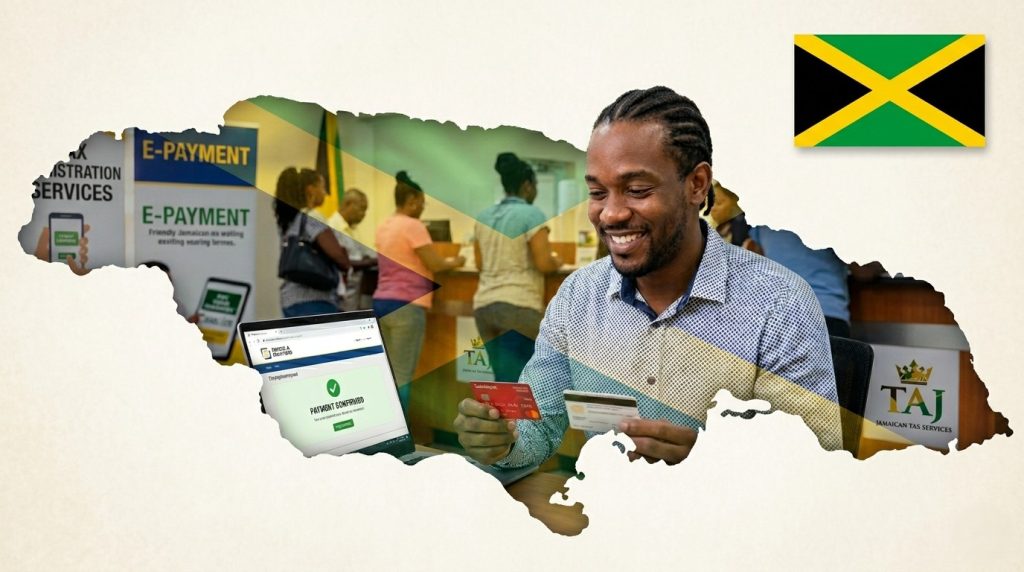
How does tax residency affect Jamaican remote workers?
If you live in Jamaica, you are a tax resident of Jamaica — and that means Tax Administration Jamaica (TAJ) has a claim on your worldwide income. It does not matter that your employer is based in the US, Canada, or the UK. It does not matter that your salary hits a Payoneer account or a foreign card. If you reside in Jamaica, that income is subject to Jamaican income tax.
This is the single biggest misunderstanding among Caribbean remote workers. The assumption is that because your employer is overseas and no taxes are being withheld from your pay, you are not liable. That assumption is wrong and it is costly.
The good news is that Jamaica has double taxation treaties with the US, UK, Canada, Germany, France, Denmark, Israel, Japan, China, and CARICOM member states. If your overseas employer withholds tax and you have paid it at a rate equal to or higher than Jamaica’s 25%, you will not pay it twice. But — and this is important — you still have to file.
What are Jamaica’s income tax brackets and statutory deductions?
Jamaica operates a tax-free threshold currently set at JMD 1,700,088 annually. Anything you earn above that is taxable. Income up to JMD 6 million is taxed at 25%. Income above JMD 6 million is taxed at 30%.
But income tax is not the only thing you owe. As a self-employed remote worker, you are responsible for four statutory deductions:
- National Insurance Scheme (NIS) — 6% if self-employed (you cover both the employee and employer portions, capped at JMD 3 million)
- National Housing Trust (NHT) — 2%, refundable after seven years
- Education Tax — 2.25%
- Income Tax — based on the bands above
When you add these together, someone earning under JMD 6 million a year is looking at roughly 30% of their income owed to the government. This is why financial planning from the start matters so much.
How do I register with TAJ and file as a self-employed remote worker?
The process is more straightforward than most people expect. Here is what you need to do:
- Get your Taxpayer Registration Number (TRN). If you have a Jamaican driver’s licence, you already have one — they use the same number.
- Create an online account at jamaicatax.gov.jm. You will need an email address, basic ID information, and a few security questions.
- Write a letter to TAJ requesting to be treated as a self-employed person. This is a specific step for remote workers with overseas employers — it lets you file using the self-assessment return rather than the PAYE (Pay As You Earn) system, which assumes a local employer.
- Set up the relevant taxes within your online account: income tax, NIS, NHT, and education tax.
TAJ’s website includes brochures specifically on income taxes for self-employed individuals. Their helpdesk is also genuinely helpful — you can call, visit a tax office, or message them through the online portal.
For Caribbean professionals who have always had taxes handled by an employer’s accounts department, this shift to self-reporting feels daunting. But once you set it up, the quarterly system actually makes it manageable.
What business expenses can a Jamaican remote worker deduct?
One of the advantages of being treated as self-employed is that you are taxed on your net profit, not your gross income. That means legitimate business expenses can reduce your tax bill — legally.
Expenses that a remote worker can typically claim include:
- Internet costs — essential to doing your job
- Telephone bills — where used for work purposes
- Utilities — proportional to work use
- Computer equipment — claimed as a capital allowance over time
The key word here is proportion. You have to be able to demonstrate that the expense was incurred wholly and exclusively to generate that income. If your internet bill is split 50/50 between personal and work use, you can claim 50% — but you need to be able to defend that split if you are ever audited.
This is why Colette’s advice matters so much: keep a separate account for your professional income and expenses wherever possible. When tax time comes, clean records make everything easier.
Frequently Asked Questions
Do I have to pay taxes in Jamaica if my employer is in the US and no tax is being withheld? Yes. As a Jamaican tax resident, you are responsible for your own tax compliance. No withholding from your employer does not mean no tax owed. You must calculate and remit your obligations yourself through the TAJ portal.
What is the filing deadline for Jamaican remote workers? Your annual income tax return is due by March 15 for the prior year. However, TAJ encourages self-employed individuals to file quarterly estimated payments — due March 15, June 15, September 15, and December 15. NIS, NHT, and Education Tax are remitted monthly by the 14th.
What happens if I do not file? Late payments attract interest of approximately 16.62% and penalties. More importantly, non-filing is not optional — taxation in Jamaica is voluntary compliance in the sense that you self-report, but it is a legal obligation, not an opt-in.
Can I claim my home office as an expense? You can claim a proportion of utilities used for work. Keep detailed records, pay work-related bills from a dedicated account, and document your usage pattern so you can support the claim if reviewed.
Key Takeaways
- Living in Jamaica means you owe Jamaican tax on your worldwide income — regardless of where your employer is based.
- Four statutory deductions apply: income tax, NIS (6% self-employed), NHT (2%), and education tax (2.25%) — roughly 30% of earnings under JMD 6M.
- Register with TAJ by creating an online account at jamaicatax.gov.jm and writing a letter to be treated as self-employed.
- Keep separate accounts for your professional income and expenses to make filing and audits much simpler.
- File quarterly to avoid a large lump-sum liability in March — TAJ’s system supports this and will thank you for it.
- A tax treaty with 10+ countries means you likely won’t pay twice — but you must still file a return and apply the credit yourself.
Taxes as a remote worker in Jamaica are your responsibility — but they do not have to be overwhelming. Get your TRN, set up your TAJ account, keep your records clean, and file quarterly.
Download the free Jamaican Remote Worker Tax Guide, and listen to the full episode for the complete conversation with Colette.